

So, I played an oft-disparaged game I’d been putting off for a long, long time. Then, I tried to judge it impartially, and typed up a three part review for the relevant community, which I later screenshotted and posted in another community. Then, someone in that other community expressed surprise that I hadn’t simply made the review on TandemShock.
To which I responded… “Wait, we write game reviews on TandemShock?”
Yes, in our early days, one of Ferny’s objectives was to post game reviews to this website. It has been over 10 years since our last game review. I suppose I’ll be reviving this column at least one more time today.
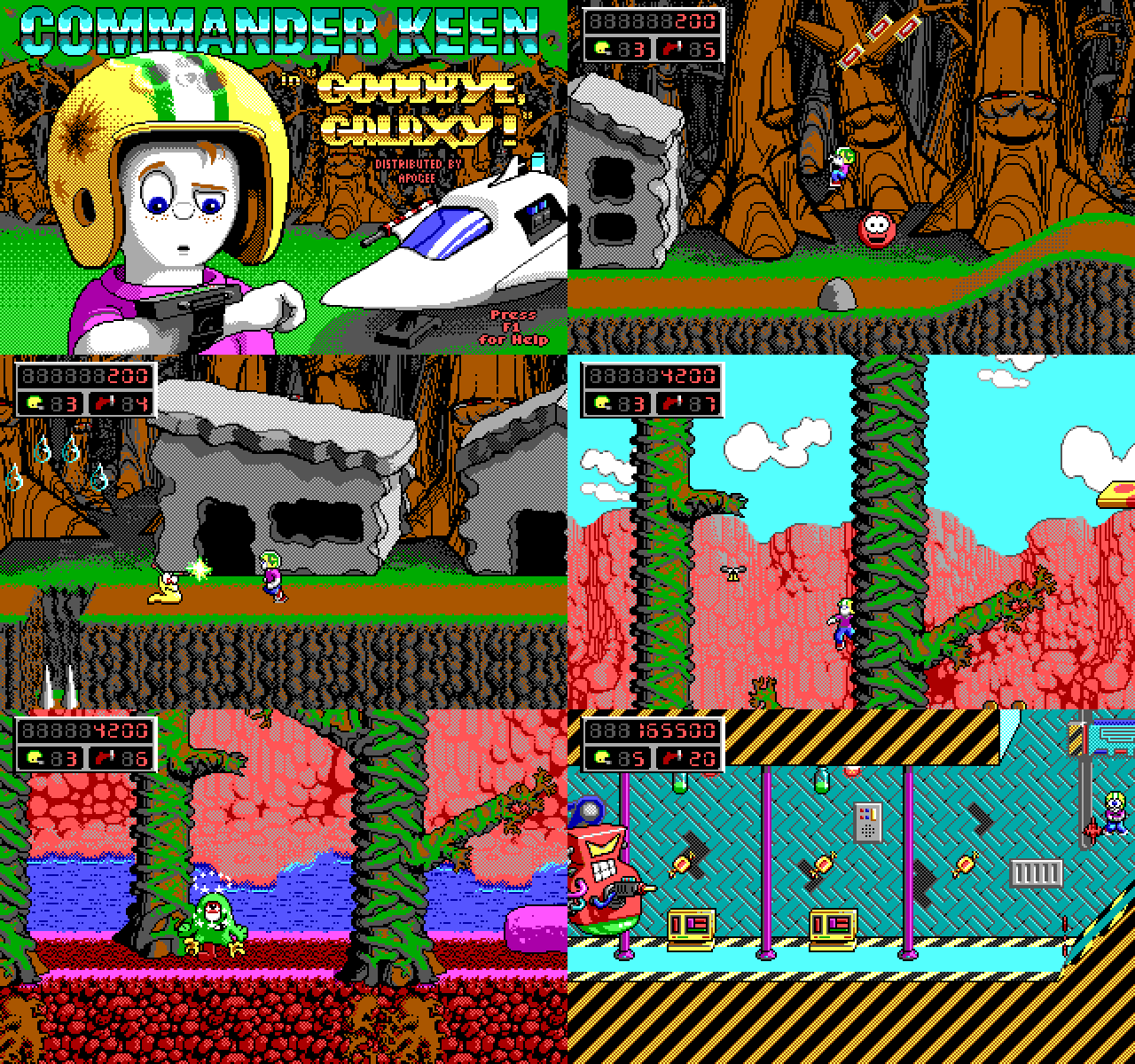
Commander Keen 4 thru 6.
I’ve spoken at great lengths about Bomberman, one of my favourite video game franchises of all time, but I can’t recall having even mentioned my other favourite: Commander Keen. My mom believes I turned out the way I did because, while I was in the womb, I was listening to the bleeps and bloops of a PC speaker as my avid gamer dad played DOS games such as Sopwith late into the night while my mom was trying to sleep. Home computer gaming was evolving, though, and my dad and his co-workers were always copyin’ them floppies and swapping with each other at work. At some point, we ended up with Commander Keen 4: Secret of the Oracle and from there, the rest of the original Keen games. I’d never seen anything like this game on our old computer screen – far from the black backgrounds peppered with neon lines, it was like watching a whole world come to life, a world we could interact with ourselves. The fully realized soundtracks, the marvelous smooth screen scrolling, the vibrantly animated characters – for a kid from a home where we weren’t allowed to have a game console, this was a most wondrous experience. It was from that moment that I was hooked, that the entire trajectory of my life shifted, and I knew that I wanted to bring interactive worlds to life, too.
I’ve been a Keen nut (or “Keener”, as we call ourselves) my whole life. I still remember when I turned 8 years old and thought to myself, “Hey, I’m as old as Commander Keen now!” Or when I wanted to be Keen for Halloween, but my mom gently guided me away from that to other options. (Of course, if I cosplayed Keen now, I’d totally be the Grand Intellect instead! Ah ha ha!)
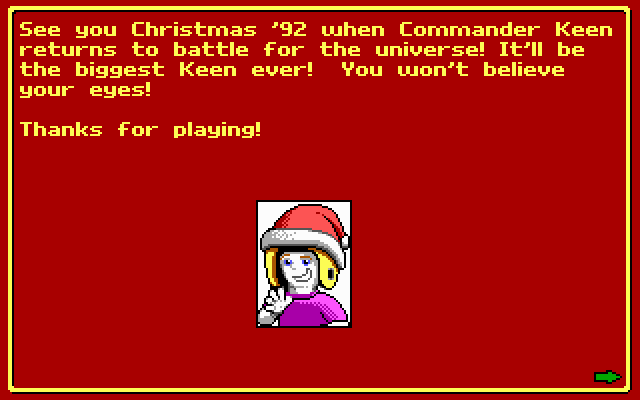
The infamous sequel teaser from the last game’s ending.
Unfortunately, Commander Keen ended on a cliffhanger. Despite promising the exciting conclusion of the overarching storyline come Christmas 1992, there was never a Commander Keen 7-9, there was never a fabled The Universe is Toast. id Software wanted to move on and make more ambitious works, and even though Tom Hall’s ambitions for Keen were prototypically similar to what would eventually emerge on the scene as Super Mario 64 just 4 years later, id Software was thinking more along the lines of Doom. Keen was silently shit-canned and left to die, and the series’ creator and director – Tom Hall – was ultimately fired after a stint of having his contributions to Doom rejected, ignored, or misattributed; thus the IP was not only shelved, but the very man integral to its heart was completely severed from it.
10 years after the final official Commander Keen released, after half of id’s four co-founders were gone, and after the world had moved on, id decided to dip into its back catalogue of IP’s to try to tap into nostalgic yearning. This is how Commander Keen for the Game Boy Color came to be. It is a game which is, within moments of playing, observably, fundamentally different from the original franchise, in both game mechanics and level design. It is a game which butchers up its source inspirations into a fetid nostalgia stew with no sense about it. It is one of those Game Boy platformers with the huge-ass sprites that fill the tiny screen. It is a soulless cash grab that ostensibly seeks to continue the story (this time, the bad guy tries to destroy the universe!) without any of the creative leads actually on board, and thus, it is not considered canon by Tom Hall or the fanbase itself.
It is… actually not a terrible game?
The Bottom Line
Is this a bad game?
No.
Is this a good Commander Keen game?
No.
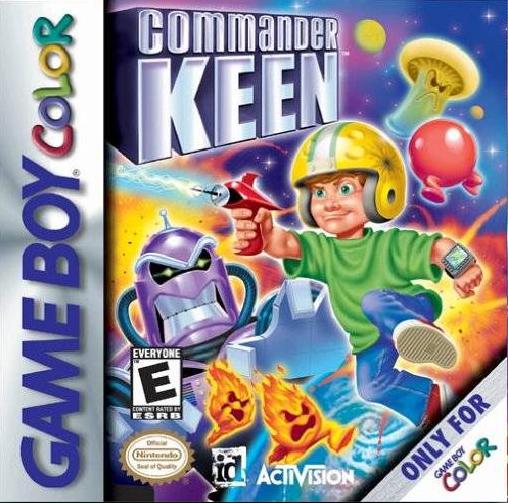 Activision/David A. Palmer Productions
We have Commander Keen at home…
I’ll split this into three sections: The Good, The Bad, and The Unkeenly. In the first two sections, I’ll analyze this game’s merits, disregarding the Commander Keen branding, as a game itself. Afterward, in the third section, I’ll try to examine why this game, which isn’t really a bad game, falls so flat for most Keen fans.
The Good
Despite the small resolution and large sprites, control is generally tight. Platforming doesn’t feel slippery or unfair. Deploying the pogo stick uses down + A, but it’s very responsive and the pogo itself is easy enough to control, albeit not as smooth as the pogo controls in the Goodbye Galaxy engine (used in Keen Dreams and Keen 4-6.
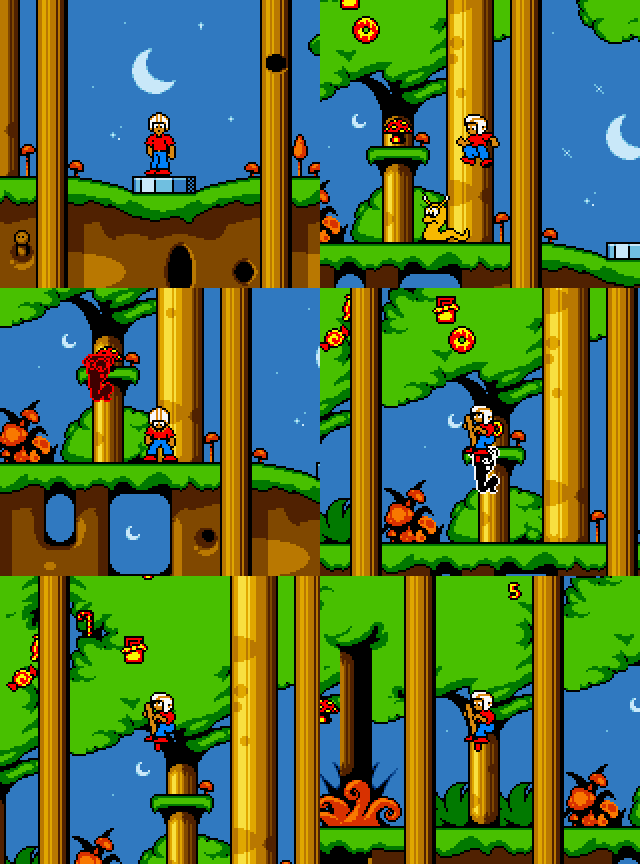
Movement in general feels pretty O.K.
There is no ammo system; instead, only 1 shot may appear on screen at a time, and enemies are only stunned for a few seconds. While an enemy is stunned, it may be pogo’d upon to eliminate it from the screen. Defeated enemies don’t respawn, even if you lose a life – speaking of which, in lieu of Galaxy‘s save-state system, Keen simply respawns at the last position he was standing, with a screen refresh and some invincible frames thrown in for good measure. It’s pretty sound, and keeps the game rolling without forcing a reset… It feels like, for the GBC, a logical step away from Galaxy‘s save system (In Galaxy, the player can save the game at any time, similar to save states on an emulator – before those were a thing!). Lives can also be acquired pretty readily in easy mode. In the event of a game over, the player has to use one of their limited continues, but these can also be acquired -: lives are gained by points accrued, continues are gained by total number of point items accrued. It’s very forgiving on easy difficulty, although if you’re playing for score, you’ll have to play the whole game without getting a game over. On higher difficulty settings, though, because the requirements for getting a life or a continue are higher, it becomes a lot harder, although this is usually not a problem (until it becomes a pretty big problem… more on that later).
The level design is generally fun, requiring some exploration while offering optional detours to gather items. From a gameplay perspective alone, it’s a pretty fun game: jump and pogo around, explore and collect point items, shoot enemies and pogo on them, find keys and switches to progress or unlock extra routes. There’s even a new clue system, as arrows or question marks appear in certain locations to direct Keen… it’s particularly helpful given the small screen size, to know when there’s absolutely nothing more off to the side, so you don’t jump to your doom.
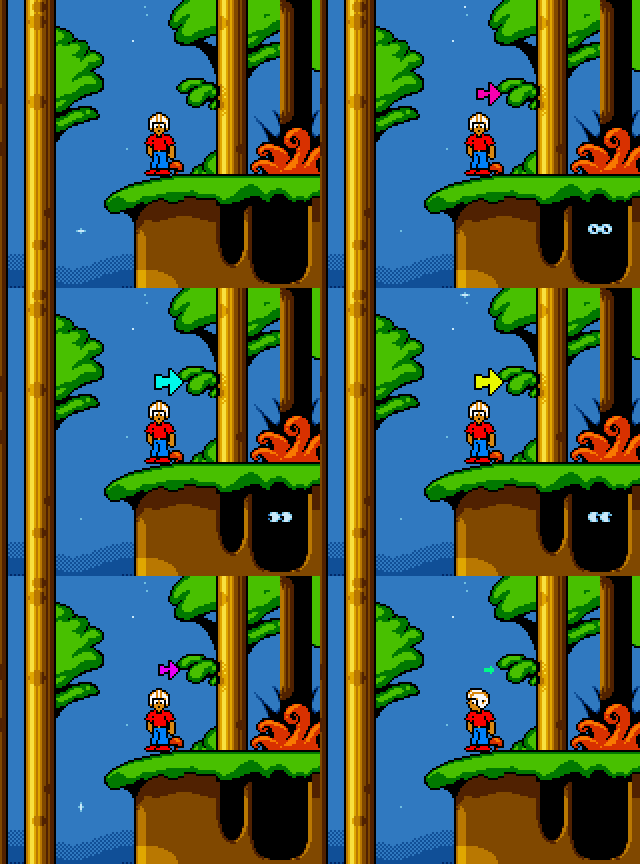
Arrows tell Keen to turn back, and question marks indicate a secret.
There are three boss fights, and they’re not anything to write home about, but neither were the bosses of Commander Keen 3 or Keen Dreams (the only Keen games to feature boss encounters). They’re a nice enough change of pace (at least on easy mode!), and the game doesn’t focus on them. I think Keen has room for boss design, but, well, it just never did it in the first place, and that’s fine. Not every game needs bosses.
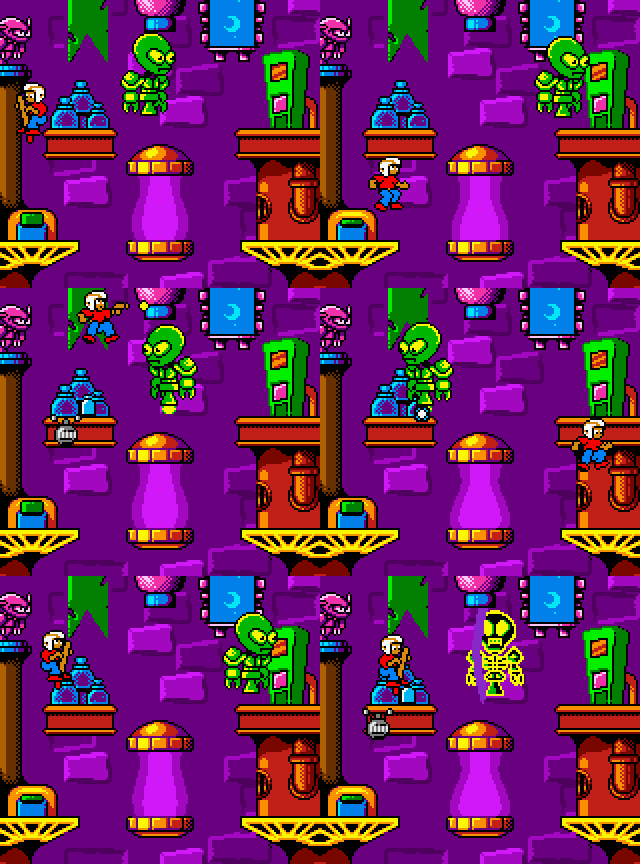
Press the conveniently-placed switch to hurt the boss.
The graphics, particularly the backgrounds and tilesets, are quite pretty to look at, providing a lot of fun visuals and diverse landscapes. The music and sound effects are generally inoffensive, and pretty nice at best, although the music lacks the jazzy vibes inherent to the original series. I found the track that plays in Fiery Canyon to be pretty smooth. I say “generally inoffensive”, but if there’s an offensive sound to be heard in this game, it’s the rather lengthy one that plays after completing your final boss fight.
Overall? Well, I played through it thrice, once on each difficulty setting, and that’s not something I can say about any old random game… but on the other hand, it is a Commander Keen game, and I haven’t felt too well lately. It’s still a game I might play again, but maybe I’ll stick to easy mode (or just use save states on the bosses for medium mode), for reasons you’ll soon know…
The Bad
Despite what I said about the game working within the limitations of its screen size, there are still some areas where you’ll find a drop that seems fine, but will still kill you. You can look up and down like you can in Galaxy, but sometimes you just might not hit where you think you should…
…And on top of that, sometimes background elements look like platforms when they’re really not, and vice versa! Remember how I said how pretty the graphics are? Well, they’re a little too pretty for a GBC game… There’s so much detail, black lines and all. You’ll find spikes and animated toxic barrels that are just harmless set dressing, a dangerous fire trap spouting out of the ground while nearby is a… a something that is just as red and orange, but it’s not animated and it’s just a background element, so it’s harmless. Occasionally, even enemies will blend into this, creating a mess of visual clutter which creates an unintentional (and unenjoyable) challenge.
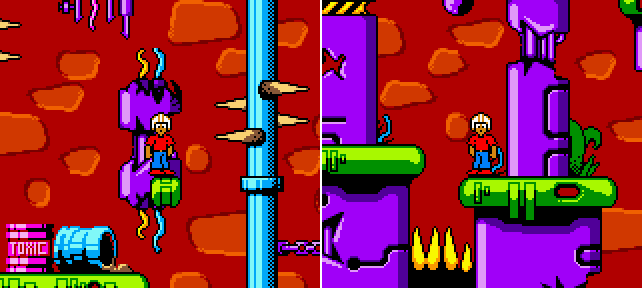
Left: Harmless spikes. Right: dangerous spikes.
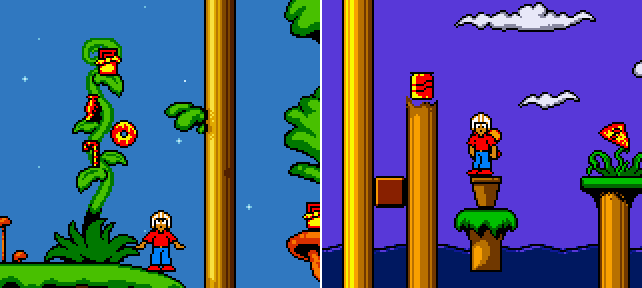
Left: Many small platforms adorned with point items. Right: Don’t try to land where this soda is or you’ll fall and poop your pants and maybe die.
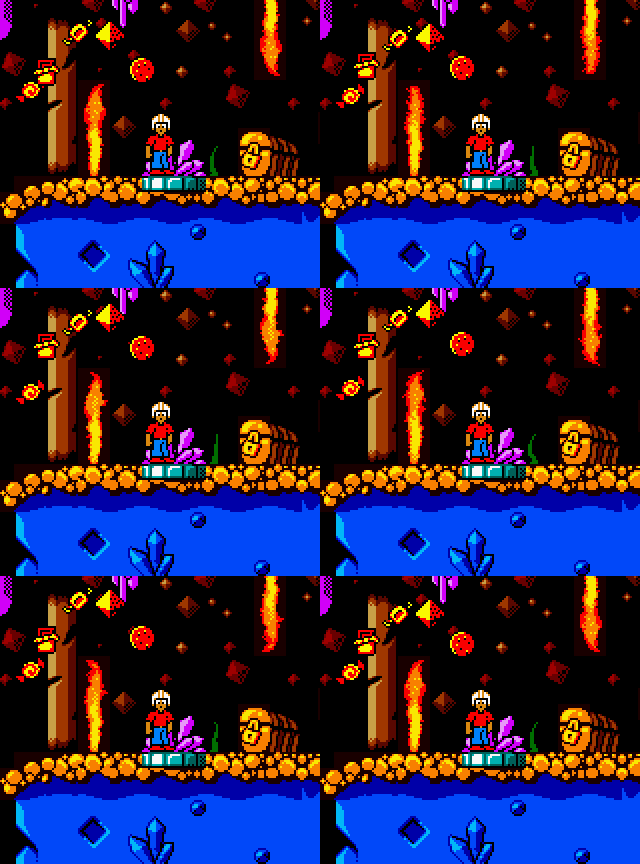
These flames are dangerous…
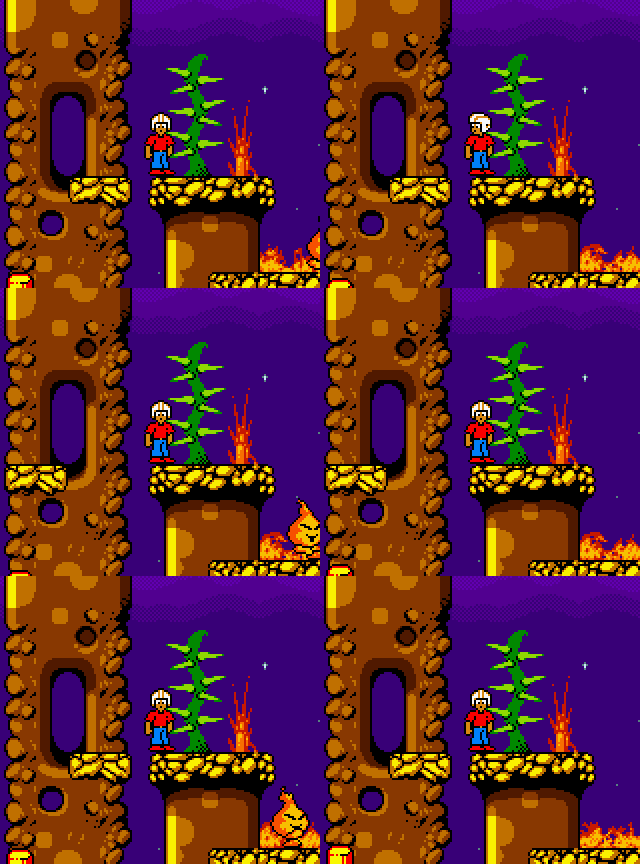
…Whatever these are, they’re not! But the animated flames down below are.
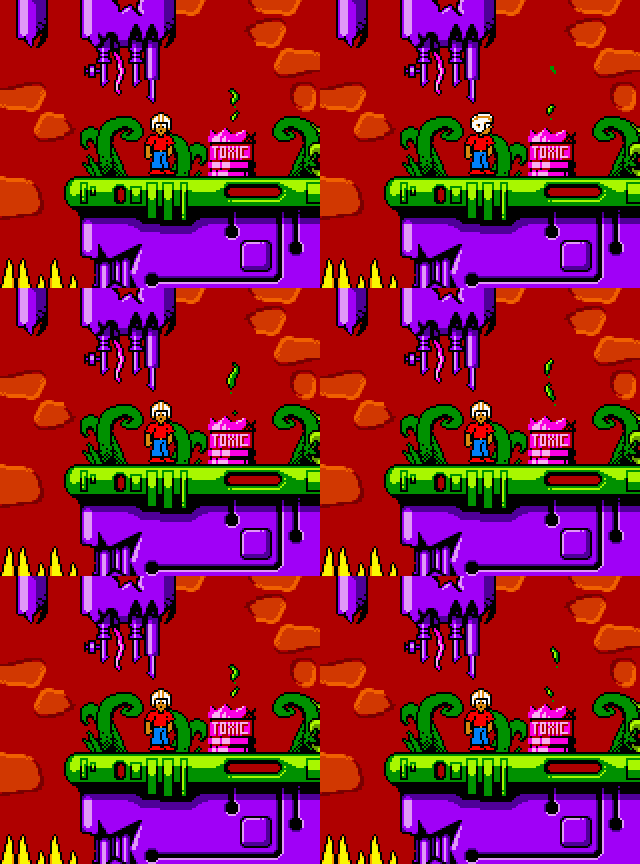
Animated barrel with a TOXIC label? Not dangerous.
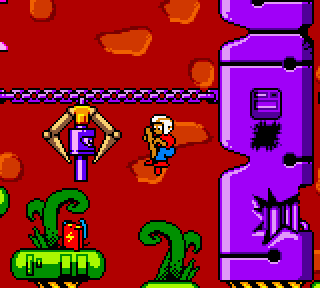
But this static sprite of an enemy held by a crane absolutely is!
While pogoing feels fine, it’s a bit awkward that you have to press A when you hit the ground to pogo higher, instead of simply holding down the A button like in the 6 previous Keen games – a baffling decision. Additionally, jumping without the pogo is a bit… Prince of Persia esque, maybe somewhere between jumping in Vorticons and jumping in Prince of Persia. It feels sluggish, difficult, almost a tinge of realistic, instead of letting Keen fly up into the air and dance on Newton’s grave with mobility. If you want mobility, you have to pogo, but it comes at the cost of, well, having to pogo. Yes, the controls are tight, but they take some real getting used to, and they might turn a lot of folks away.
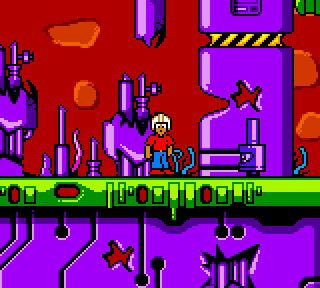
Sometimes enemies blend into the background colours, too.
It’s a minor complaint, but score items are aesthetically awkward for multiple reasons in this game, but the most generic reason is that their appearances do not tell you how many points they are worth. A basic lollipop could be 5, 10, 25, or even 50 points, it seems. It all depends on where it is in the level. Right on the main pathway? Probably 5 or 10 points. Harder to get? 25, even 50 points if it’s in a treacherous spot. But it’s always the same lollipop – same graphic, same palette, nothing special about it. Heck, the palette for all score items is the same across the entire game, although it appears that at some point, the palettes were at least going to be level-dependent. Perhaps the thought process was, “well, they’re small and they’re on a small screen, and there are so many sprites for them, so it doesn’t matter”. Whatever the case may be, it’s oddly unsatisfying and kind of jarring to go out of your way to find a couple 50 point items that just end up looking exactly like the 5 point items you’ve been grabbing throughout the rest of the level proper.
While this didn’t bother me personally, I should also make a note that my good pal Ragey had to dip quickly from my livestream of the game because the small screen size + large sprites = constant screen motion, yielding some serious motion sickness.
And then we get to the difficulty settings.
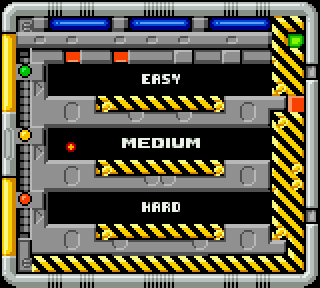
“Medium” is a weird name, right? Isn’t is usually “Normal”?
This game has three difficulty settings: Easy, Medium, and Hard. Most of the glowing remarks from my notes came from my easy mode run. On the other two difficulty settings, problems start to arise. In fact, coming back to play on medium mode after having completed it on easy, it felt like a very different experience.
First off, the most obvious change is that both Keen’s movement and enemy movements become faster at harder difficulty settings. Why does Keen’s movement increase? The simple answer might be that it just makes the whole game run faster instead of beefing up enemies, but it ultimately changes the way he plays, and in some ways, actually makes movement easier on hard mode and harder on easy mode. Because Keen can make faster jumps, I found it easier to just jump him across a number of pits that necessitated the pogo for me on easy mode. As the difficulty increases, there is even less delay after the pogo stick hits the ground before it jumps again, which makes pogoing less tedious and more responsive on hard mode than on easy mode.
Keen’s increased speed also exposes some flaws with collision detection in the more precarious areas of the game. Collision physics with single 8×8 pixel blocks doesn’t always work the way you’d think it would, and I would often watch in vain as Keen clipped through the side of a tiny block I was trying to drop onto. I said the physics were “tight” in the first section of this review, but it’s like they almost become tighter and tighter as the speed of the game increases until it’s too tight.
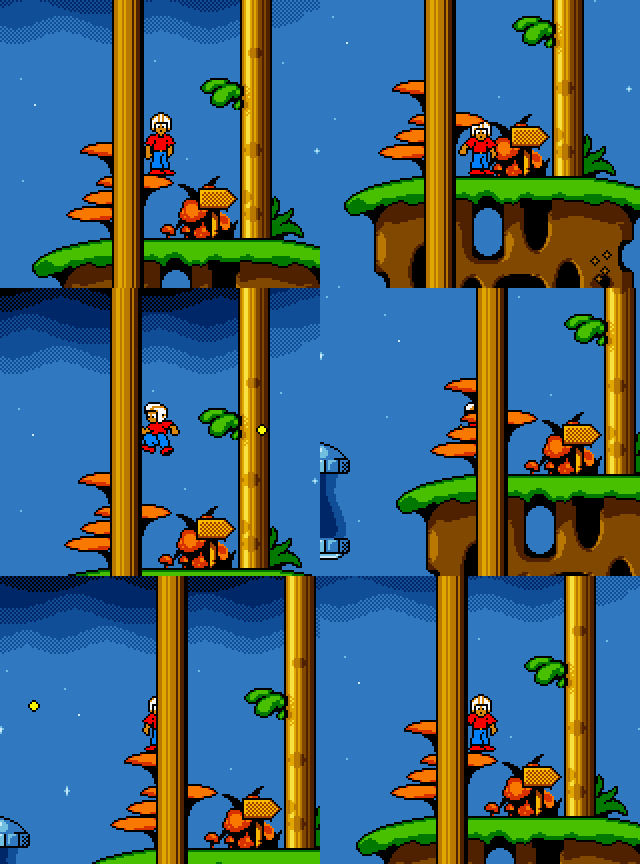
Platforming can both look and feel confusingly inconsistent.
The next thing is that, in addition to moving faster, a number of enemies gain additional behaviours. For example, the Gik, which simply pace back and forth on easy mode, now jump up into the air sporadically while pacing on medium mode, and the Arachnu, which was similarly just a simple pacer on easy mode, in medium mode jumps into the air whenever the player pushes the shoot button. These behaviours are fun and interesting, and it’s a shame that they’re locked into higher difficulty settings, because it makes easy mode (and even medium mode, in some places) feel boring, with many enemies reduced to being simply reskins of the same pattern over and over again.
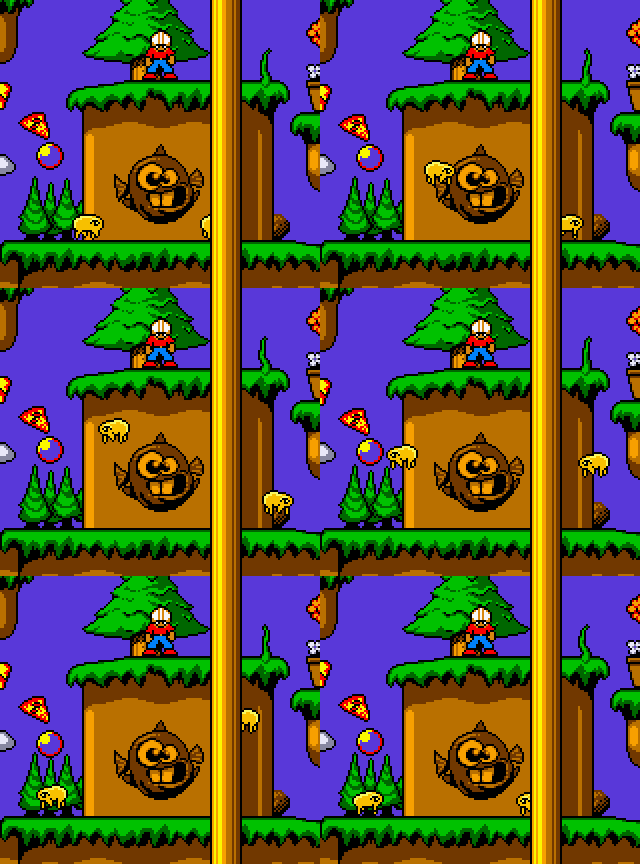
Dopefish Lives.
Enemies that shot projectiles in easy mode get these behaviours beefed up at higher settings, which can range in dumbness from “this enemy now rapid-fires in a horizontal line in its facing direction” to “this enemy now throws projectiles directly at Keen even while it’s facing away from him” all the way to “the first thing I said, but also, in hard mode, that enemy is often placed off-screen over a big pit so it’s hard to shoot/pogo combo it and see where it even is and also try to land on the moving platform you need to cross the pit”. That last one is particularly a doozy. Have fun trying to pogo into the abyss hoping your shot hits and theirs doesn’t, while also not flinging yourself off, and then have fun trying to land back where you started from and pogo back and hit the enemy with your pogo before it quickly revives and kills you via either collision damage or blaster to the face. That particular scenario comes up multiple times in succession in that Fiery Canyon level I mentioned earlier, and the enemy in question is the Droidican Elite. That’s right, this is my call-out post. Fuck that level and that enemy in particular. On my hard mode run, I’ll confess I ended up resorting to save states mid-level to clear those obstacles, something I’d avoided beforehand (excepting bosses on medium and hard). After that, I was frustrated enough that I just kept using save states for tough areas for the last level (or two? I can’t remember) of the game. It was that annoying, and I’m too old to put up with that special kind of annoying in game design.
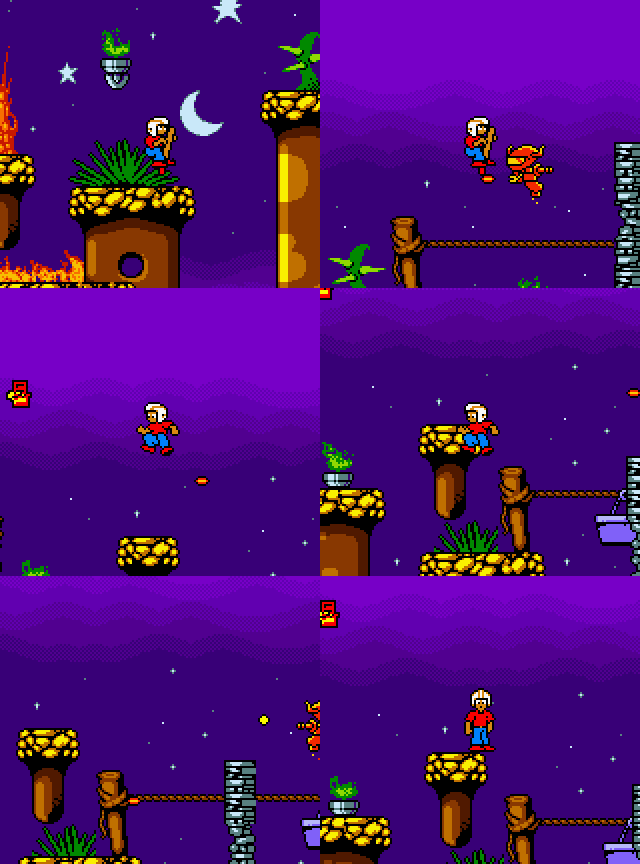
I make it look easy, but the amount of lives I lost the first time I got here on hard mode…
I feel like a middle ground between all of these speed and behavioural adjustments would be preferable to the game’s difficulty setting approach, but alas, that is not the game that we got…
The game’s three bosses gain an additional +1 hit point per difficulty mode, starting at 3 HP on easy mode and ending at 5 HP on hard mode, and of course, they move faster, too. These are ultimately the game’s biggest, gnarliest gauntlets, and on medium or especially hard mode, they can burn through all your lives and maybe even all your continues in a flash. If you run out of everything, it’s back to the title screen, and no, you can’t load your save file, because this is a game from 2001 that uses a lengthy password system. For the most part, the Robo-Bloog is the most frustrating experience in the game. The boss asks the player to activate a switch to damage it, at which point it will fire a heat-seeking bullet while it walks back and forth on the left side of the screen, and all of this action takes place on one singular (non-scrolling) screen. I wasted all my continues trying to figure out a surefire pattern that would dodge both it and its Keen-chasing bullet, so I ended up just using save states rather than messing with the password system and having to play through the long level that precedes the boss only to surely die again while slowly learning how to play it. This isn’t like Mega Man, you can’t try and breeze back through the level again, or go to another level and find a weapon the boss is weak to, or you know, actually have hit points of your own. It’s just grueling. The other two bosses are not as bad; the Droidican Emperor is all about hitting the switch at the right time while dodging another heat-seeker and a thrown projectile (which is still difficult on harder modes), while the Shikadi Overlord is ridiculously easy by comparison to the other two – simply shoot it when it’s generating a bullet. It’s beatable without losing a single life.
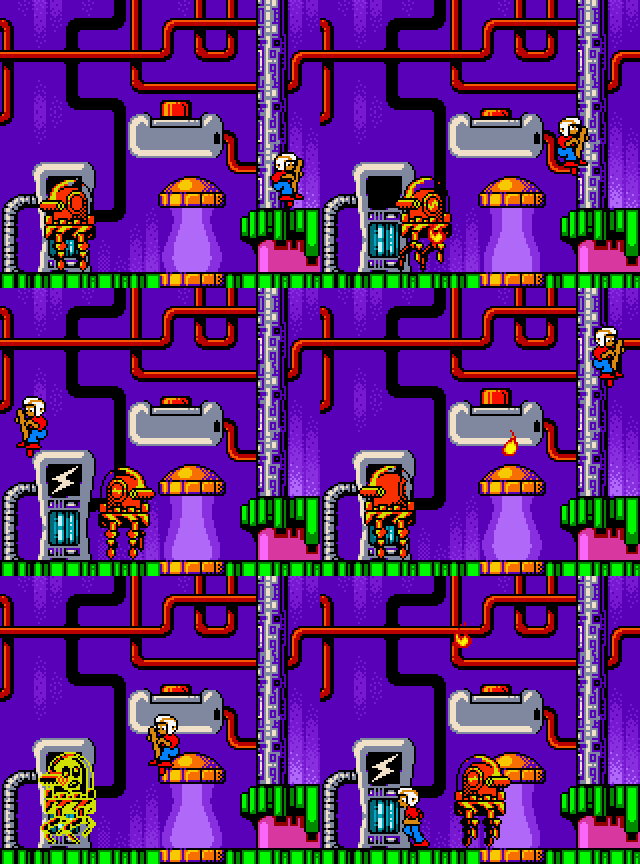
Pogo up, hit the switch, dodge the bullet and the boss, repeat.
For all your efforts, you’ll be awarded with an ending that mostly just recycles the assets you’ve already seen in the intro and throughout the rest of the game, followed by a single screen of text. It’s not much, and it feels like less than what the old DOS games provided, but at least it’s something!
The Unkeenly
So what makes this game such a bad Commander Keen game? Who worked on this, anyway?

Was it one last trolling attempt from Mortimer McMire?
From the original Keen team, the only returning staff are Adrian and John Carmack. Adrian Carmack brings his graphical sensibilities, while John brings the programming (and is supposedly the one responsible for suggesting the game as a potential project). But the soul of Keen is missing, and it’s sorely felt. Names, enemies, and locations from the original Keen games are thrown into a blender and slopped out senselessly. Enemies from Gnosticus IV (Keen 4) appear on the Shikadi (Keen 5) homeworld, which itself, as a location never seen in the original games, looks more like Gnosticus IV. Miniature Dopefish (the memetic monster originating from Keen 4) jump out of the water on Fribbulus Xax (Keen 6), now an Earthen palm-tree-laden planet where you’ll also find two-eyed earless Fleex (whose booklet description appears imported straight from Keen 6, mentioning their iconic big ear!) and Flects who, despite having lost their teeth, still reflect your shots. A classic burping Dopefish appears prominently on a random wall. Dopefish forever! Remember?? Remember the Dopefish???
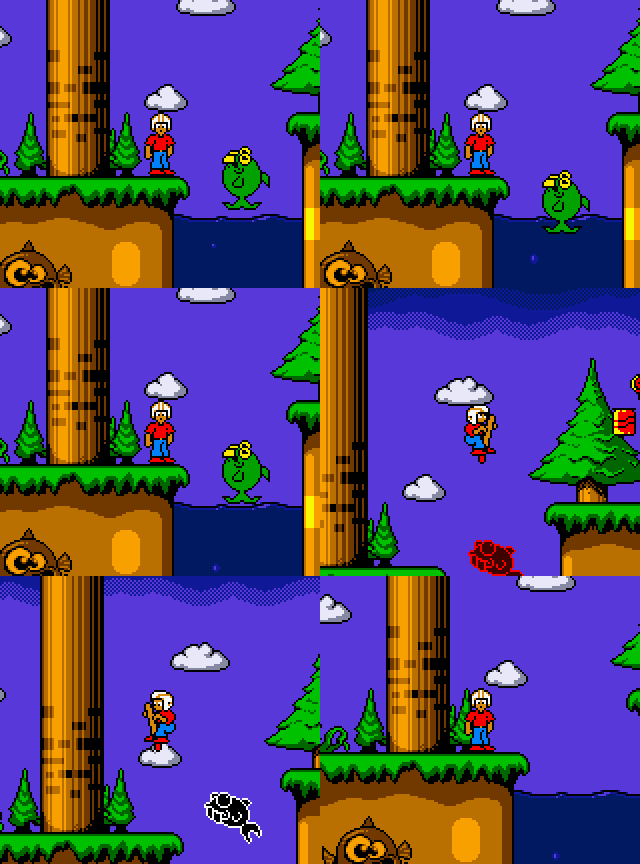
I don’t remember the Dopefish like this…
On easy mode, there are scarcely any mechanical differences are between a lot of the enemies. Traditional Keen games were each full of enemies that all had unique behaviours – the one that laid traps, the one that threw fireballs, the one that jumped at you when you weren’t looking. Some enemies could be shot, some only temporarily stunned, some were totally invulnerable, and in a few cases, you’d have to stomp or pogo on them to defeat them. In this game, however, they’re largely jumbled together and lose a lot of their original variety. Nearly every enemy simply takes one shot and a pogo after to defeat, save for a handful who can’t be shot at all. Classic enemies like the massive, menacing, machine-gunning Robo Red now appear as small and flimsy things that go down in one shot and a pogo stick, appearing simply to justify the use of the license.
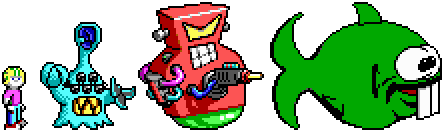
Keen, Fleex, Robo Red, and Dopefish in the Galaxy games. Fleex has 4 HP and the other two are invincible monstrosities.

The same enemies in the GBC title. All go down in one shot and a pogo, too.
I said the graphics are pretty, and I stand by this, but at the same time, they also don’t look like they came out of a Keen game. Keen explores whimsical landscapes with medieval castles complete with flags and banners, night skies covered in crescent moons and stars like a giant wizard slapped his cloak across the ozone layer, massive human skulls on a mechanical droid planet… it goes on and on. Sometimes it felt like Hocus Pocus would have been a more relevant DOS game to inherit some of these setpieces. The worlds look oddly whimsical in a way that feels more magical than sci-fi.
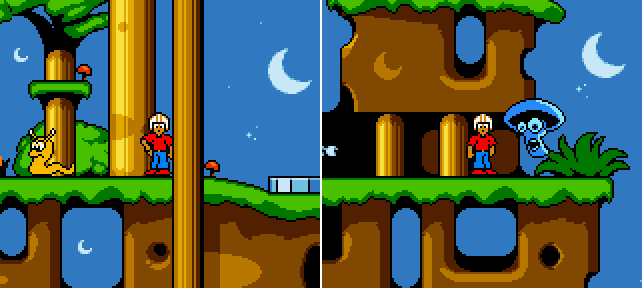
Let’s just slap moons across the sky and walls. That screams ‘space’, don’t it?
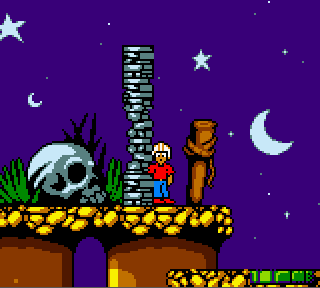
Giant human skull, big five-pointed stars… Yeah, that’s totes Buck Rogers.
The one planet that does the best in this game is Droidiccus Prime, by virtue of being a wholly new location. But even this one suffers from these out-of-place feelings, and a quick look in the booklet reveals the creative bankruptcy at hand, with some dull enemies named Droid 1, Droid 2, and even Droid 3, alongside, of course, Sentry Droid… The most interesting designs are the Droidicans themselves, but then they have to share the field with Dorp and Darg, which I’ll leave you to suss out on your own.
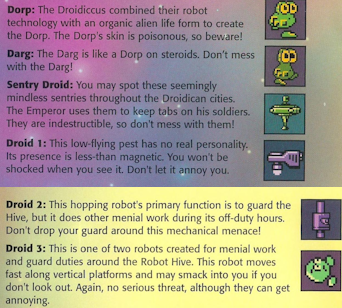 Activision/David A. Palmer Productions
Ah yes, the iconic Droid 1 from Commander Keen. And don’t forget the Yorp – er, Dorp!
Point items in Keen games were typically junk food like candy or burgers, with a few other childhood sensibilities such as plush toys, and the occasional Kant book (hey, he is an 8-year-old genius). A lot of the point items in this game are sensible and even extracted from old Keen games, but there’s really weird stuff too. Like, why is there some kind of diamond? An oldschool key? Something that is either a magical potion or a scientific flask, and I really can’t tell because the stage it’s in is like a castle but has robotic elements…
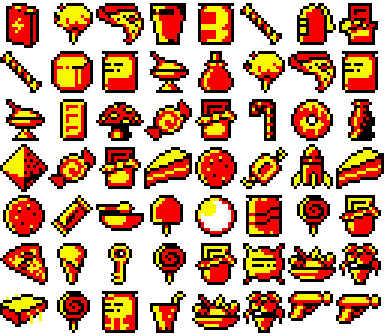
Ripped from the tiles, so there are oddities. Check out the unused ammo pickup(?).
The choices here are awkward. Some point items only appear on specific stages where it’s like they were trying to make them fit with the theme of that specific stage. I suppose a case could be made for some items, like maybe Keen would enjoy analyzing alien computer chips. But a fire extinguisher? There’s a whole level that’s on fire (Fiery Canyon, again!), and he picks up Earth-style fire extinguishers as point items. They don’t even do anything, they’re just mindlessly thematic for the sake of it, without considering Keen‘s theming – the integration of childlike elements into a cartoonish pulp sci-fi setting… You’ll be on Fribbulus Xax, the most alien and surreal planet of the original series, but you’ll be exploring Mario-like terrain with big medieval castles, spears and axes jutting out of the ground, and meanwhile you’re dodging Bloogs and collecting ancient-Earth-style keys as point items. It is truly the Commander Keen experience of all time.
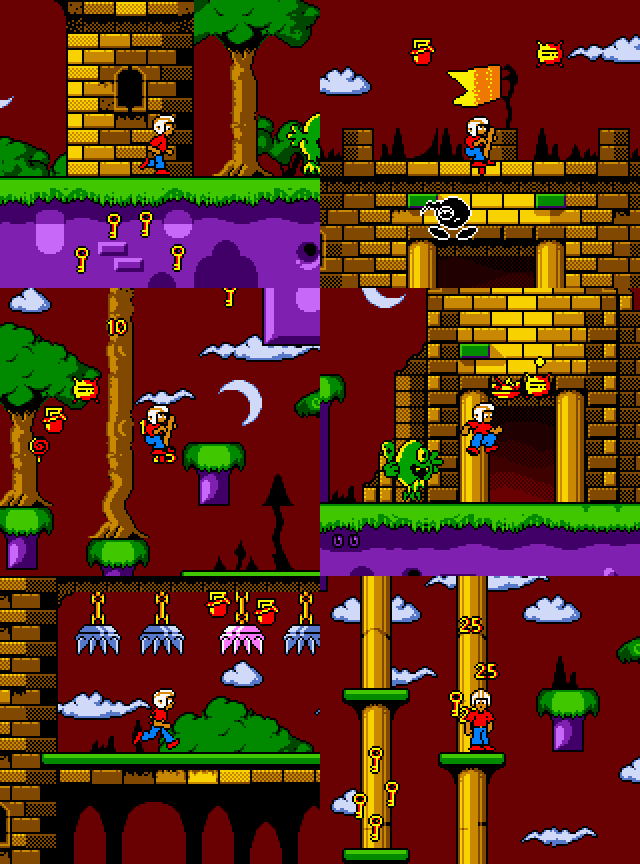
This medieval fantasy land is ostensibly Fribbulus Xax.
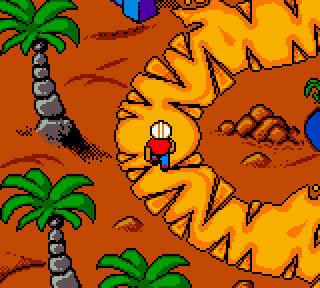
So is this Earthen desert landscape…
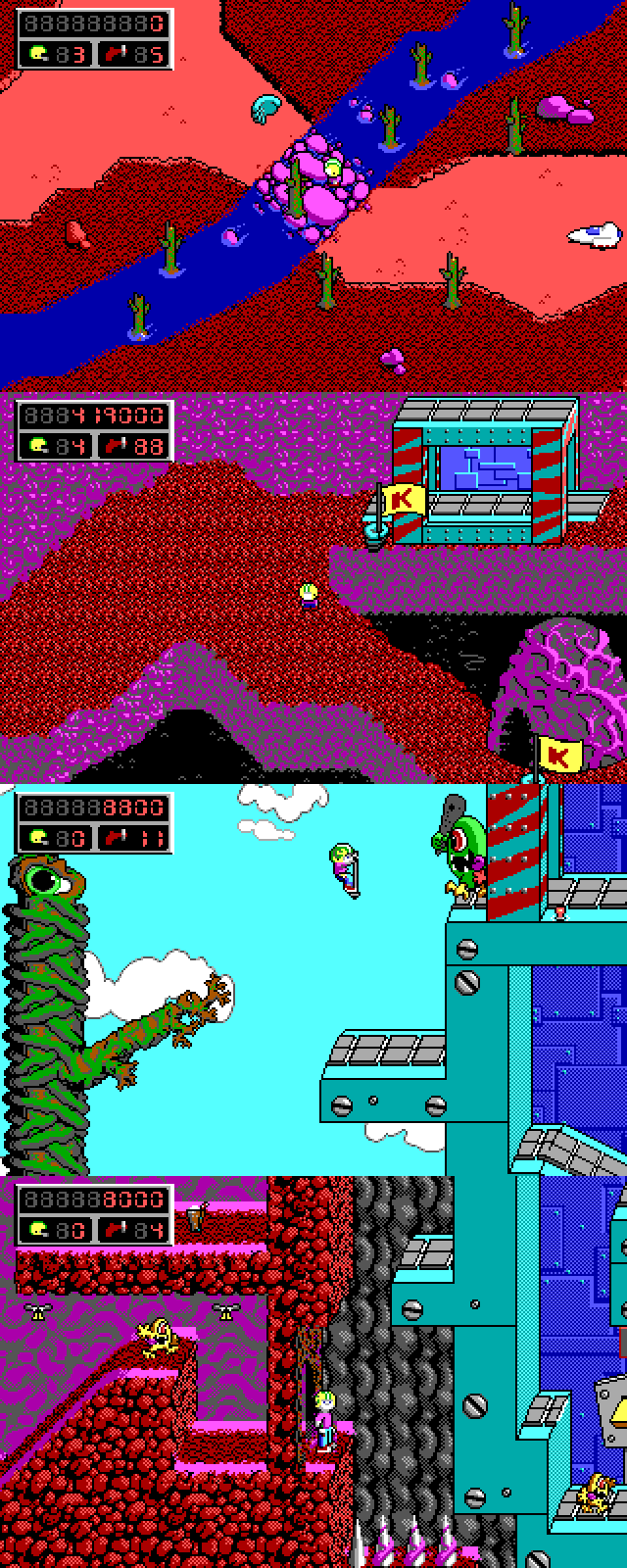
…But this is what Fribbulus Xax actually looked like. It couldn’t be more different!
Then we get to the actual gameplay, and here’s where it divorces itself even further from Commander Keen. First of all, the new pogo weapon mechanic, which I believe is often cited as a grievance among fans. While I can perhaps follow the logic that led to this outcome (small screen, unlimited ammo… maintain challenge…), it certainly feels more like DuckTales than Keen at this point. It’s a small thing, but it all adds up together. The levels themselves are comprised largely of tall, video-gamey platforms akin to those seen in Super Mario, with a healthy smattering of floating blocks everywhere. It doesn’t build an environment in the same logical manner that Keen games did, with levels attempting to resemble environments, platforms attached to structures or formed out of terrain, doors leading in and out of huts or into deeper depths of temples. If anything, the level construction lends itself more to the aforementioned “mystical” feel of the environments. The classic fireman pole from the Galaxy gamees is chucked in rarely to remind the player that this is, in fact, supposed to be Commander Keen, and yet these poles feel so out of place for how rare they are, and how pointless they seem, often standing in isolation where a platform would have been in every other similar situation in the same level. It just feels like more blatant pandering without any substance.
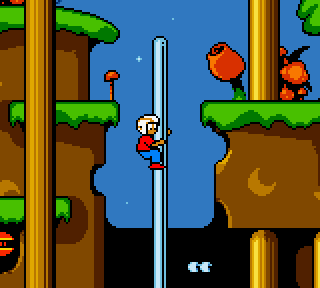
There’s no environmental storytelling or separation between two chambers, and it’s completely bypassable.
Ultimately, 10 years after the abrupt cancellation of Keen‘s promised ending, id cranked out this half-assed excuse for another cliffhanger sequel by throwing old assets together in nostalgia bait so carelessly that it almost looks like a bootleg, with no concern for actually continuing the series or dignifying the goals of its creative lead.
The Conclusion
Would I recommend this game? Honestly, yes, if you like GBC titles and don’t mind trying something a bit different, it’s still quite fun. It’s nothing groundbreaking in the slightest, but it’s a nice diversion, and brings some different ideas to the table. You’re not going to play another platformer like this, even if you play another Keen game
Do I think this is a bad Keen game? Yes, absolutely. Something can be both good and bad at the same time, by different metrics. This is certainly one of those cases, and while I may recommend it as a standalone game, I don’t actually recommend it as an entrypoint to the Keen franchise. Rather than a true sequel or conclusion to the franchise as fans have desired, Commander Keen on the GBC is just a lot of random Keen things hacked apart and then slapped back together, like Frankenstein’s monster if Dr. Frankenstein didn’t actually understand human anatomy.
The Mod
…That’s right, it’s not over yet! It’s been ages, but just like in one of our earliest game reviews, this review comes bundles with a mod! And this time, instead of just getting some skins of the dweebs who run this website, you can play Commander Keen for the Game Boy Color as MORTIMER MCMIRE himself!
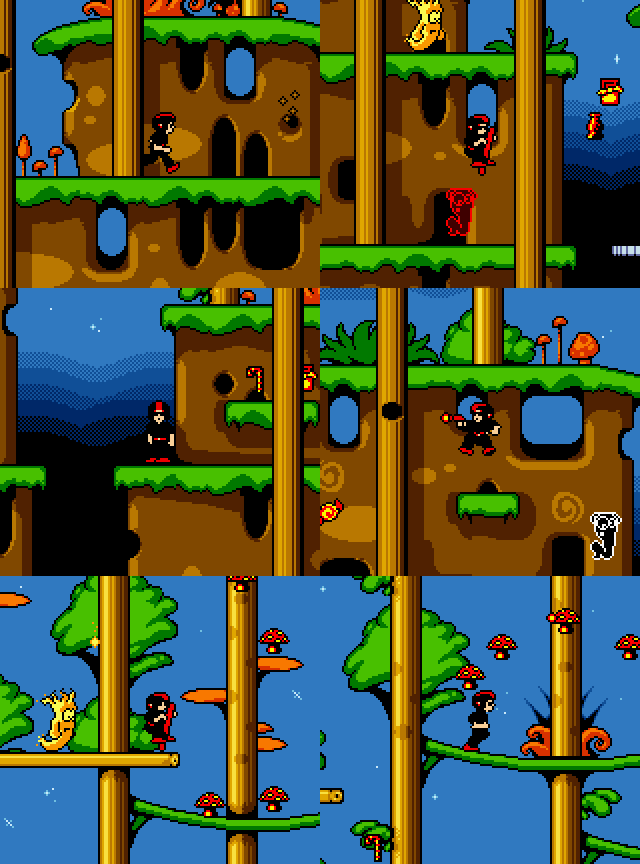
Playing as the Grand Intellect instantly makes this a better game.
In a desperate attempt to make some sort of sense out of this GBC installment’s nonsensical hodgepodge of Keen and mystical elements and generally bootleggedy feel, this mod tells the story of the Grand Intellect’s banishment to an alternate universe, and his quest to conquer that universe and maybe get home in time to destroy the multiverse!
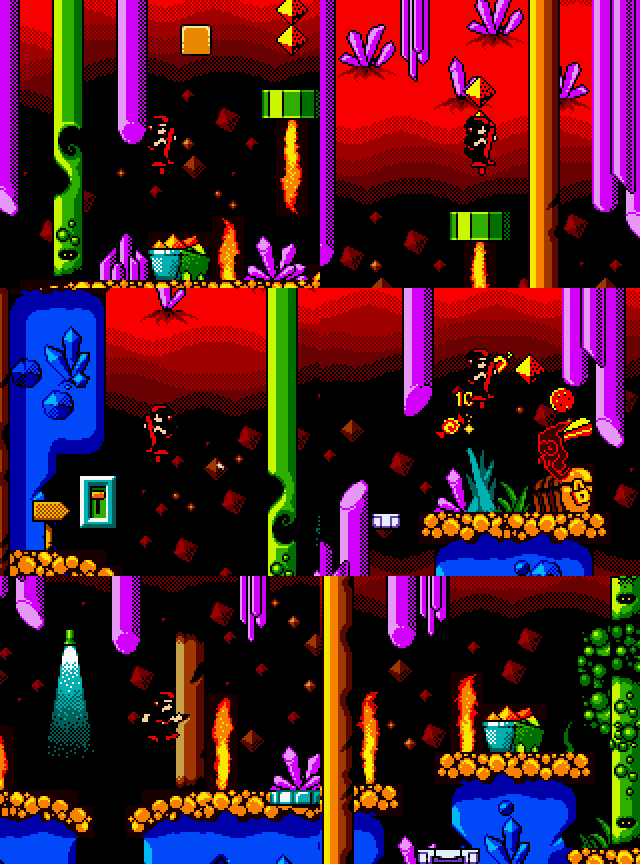
Will McMire make a mockery of this mangled multiverse? It’s up to you!
Please check the enclosed readme text file for the full story, and don’t forget to bring your own copy of the game to apply the patch. Now go play Commander Keen – er, The Grand Intellect! And thanks for reading ’til the end.



Latest from TandemShock